
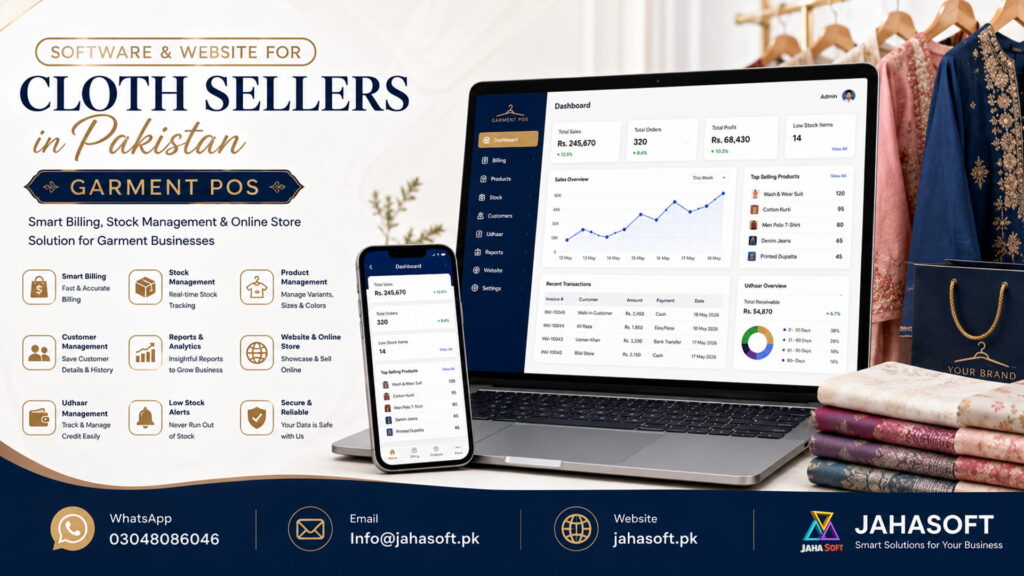
Cloth sellers need software that treats one product as many. A single kurta design in six sizes and four colours is twenty-four separate stock lines, not one. Fabric sold by gaz or meter, thaan-level purchase records, tailoring orders with measurements and delivery dates, seasonal Eid pricing and exchange-heavy customers all break generic retail software. JahaSoft builds garment systems that handle this, plus the website or online store that turns your shop into something customers can buy from at midnight.
Why generic POS software fails in a cloth shop
Take a kiryana shop. A box of soap is one product, one price, one stock number. Sell one, the number drops by one. Simple.
Now take your shop. A men’s shalwar kameez design comes in six sizes and four colours. That is twenty-four distinct things a customer can buy, each with its own stock level. Multiply by two hundred designs and you are looking at nearly five thousand stock lines behind what your catalogue calls two hundred items.
Generic billing software gives you two bad options. Either you enter one product and it lets you sell a Large in navy when you only have Small in navy, or you manually create twenty-four separate products for every design you stock, which nobody sustains past the second week.
That is the core of it. Everything else in garment retail follows from the same problem.
What cloth shop software has to get right
Size and colour matrix stock
You define the design once, then tick which sizes and which colours exist. The system builds the grid. When someone buys a Large in navy, only that cell drops. Each variant gets its own barcode, and you print the labels yourself rather than buying separate label software.
At season end you open one report and see which sizes sold out, which colours never moved, and what to reorder. That report alone changes how you buy next season.
Fabric by gaz, meter or thaan
Suit-piece and fabric sellers do not sell units. They sell length, cut from a thaan.
The system needs to hold stock at thaan level, record how much is cut off each one, price by gaz or metre at rates that differ by quality, and tell you what remains on each roll. Mixed billing matters too, because the same customer buys three metres of fabric and one readymade shirt on the same bill and expects one total.
Tailoring and alteration orders
If you stitch or alter, this is a separate workflow, and most POS products in Pakistan ignore it entirely.
You take an order, record measurements against the customer, take advance payment, promise a delivery date, assign it to a tailor, track its status, and notify the customer when it is ready. A WhatsApp notification when the order is ready cuts the number of “kal aa jao” phone calls to almost nothing. Repeat customers keep their measurements on file, so the next order takes two minutes.
Exchanges and returns without the drama
Cloth retail runs on exchanges. Wrong size, wrong colour, customer changed her mind, gift did not fit. It happens constantly and every one currently means digging through a receipt book.
Pull up the original bill by number, phone or customer name. Process the exchange. Stock corrects itself both ways. Thirty seconds, not five minutes with a queue behind.
Seasonal pricing and Eid
Eid, wedding season, end-of-season clearance. Discounts by category, by design, by percentage, on a schedule. Then a report telling you whether the sale actually made money after markdowns, which is the question most shops never answer.
Dead stock, flagged before it is dead
Fashion goes stale. The system tags anything that has not moved in sixty days so you can discount it while it still sells, rather than discovering it next year under a shelf.
Wholesale mode
If you sell in the cloth market to other shops, retail features are not enough. You need party-wise rate lists, credit terms, delivery challans, area-wise sales, and a recovery report showing who owes what and for how long. We build this into the same system as the retail counter, drawing on shared stock. Our systems for fertilizer dealers and Hassani Traders work on the same principle.
Udhaar, because of course
Regular customers buy on credit. Each one gets a ledger, credit sales add, payments subtract, and outstanding balances sort by age with optional WhatsApp reminders.
Offline first
Load shedding does not care that you have four customers waiting. Our systems bill locally and sync when the internet returns. We wrote up the approach in offline-first web app for Murky Nexus Ice Factory.
The web half: your shop after closing time
This is where cloth sellers have more upside than almost any other retail category in Pakistan, and where most are leaving money untouched.
Clothing is the single most-searched retail category online here. Your customers are already browsing at 11pm. The question is whether they are browsing your stock or somebody else’s.
There are three levels, and you do not have to jump to the last one.
Level one: a catalogue site. Your collections, photographed properly, with prices, sizes and a WhatsApp button on every product. No payment gateway, no courier integration, no complexity. Customers browse, tap, and message you. For a lot of shops in Quetta this is the entire answer, and it can be live in a couple of weeks. We covered the case for this in top 5 reasons Balochistan businesses need a website and garments website in Quetta.
Level two: a real online store. Cart, checkout, online payment, courier booking, order tracking, customer accounts. Built on WooCommerce, Shopify or custom, depending on what you sell and how much you want to manage. We did exactly this journey for Star Electric Quetta, and we build ecommerce sites and Shopify stores regularly.
Level three: shop and website on one stock file. The version worth having. Your counter and your website share inventory. Sell the last Large in navy at the counter and it disappears from the site instantly. No overselling, no apologetic phone calls, no manual stock updates at midnight. This is the integration that separates a working online business from a website that creates problems.
Add SEO on top so people searching for what you sell in your city actually find you. See SEO services in Quetta and ecommerce development with SEO. Photography and layout matter more in fashion than in any other category, which is why we treat UI and UX design as part of the build rather than decoration on top.
Who this is for
Readymade garment shops. Size and colour matrix, barcode billing, exchanges, seasonal pricing. The core system.
Boutiques and designer outlets. Fewer items, higher value, custom orders, customer relationships that matter. Measurement records and order tracking carry more weight than counter speed here.
Fabric and suit-piece sellers. Thaan-level stock, gaz and metre billing, quality-wise rates, cut tracking.
Tailors and stitching units. Order intake, measurements, tailor assignment, delivery dates, advance payments, status notifications.
Cloth wholesalers and market traders. Party rates, credit terms, challans, recovery. If you supply shops rather than consumers, this is your system.
Textile mills and manufacturers. Production plus dispatch plus dealer management. See textile mills website development and software for a cake manufacturing factory for how we handle production-side systems.
Uniform suppliers to schools, hospitals and institutions. Bulk orders on account, size breakdowns per institution, delivery schedules, invoicing against purchase orders. This overlaps with our school management software work.
NGOs and relief organisations distributing clothing. Beneficiary records, size-wise distribution logs, donor reporting. We build donor-grade audit trails, as we did on YAD Cloud and described in digitising NGOs in Balochistan.
Government and departmental procurement. Tender-based uniform and textile supply with purchase order tracking and audit-ready records. JahaSoft is UNGM-registered.
Do cloth sellers need FBR POS integration?
Some do. FBR requires Tier-1 retailers to integrate their POS with FBR’s system so each sale is reported in real time with an FBR invoice number and QR code on the receipt.
Under the Sales Tax Act, 1990, a retailer is generally Tier-1 if it operates as a unit of a national or international chain, operates in an air-conditioned shopping mall, plaza or centre (kiosks excluded), accepts card payments, has cumulative electricity bills above Rs 1.2 million over the preceding twelve months, is a wholesaler-cum-retailer importing bulk consumer goods, or has paid advance withholding tax above the section 236G and 236H thresholds.
A branded outlet in an air-conditioned plaza is almost certainly inside this. A small shop in the bazaar probably is not. Confirm with a tax advisor and against FBR’s own criteria, because notified sectors have been expanding. Either way, build on something that can integrate when you need it.
What it costs
Depends on whether you need software only, website only, or both connected. Depends on whether you sell fabric, readymade, or both. Depends on tailoring, on branches, on wholesale, on FBR.
We scope it first, then quote in writing. Nothing is charged before you agree. Our article on what a website costs in Quetta explains how we approach pricing.
About JahaSoft
JahaSoft Ltd is registered in the UK (Companies House No. 14653641), with JAHASOFT (SMC-PRIVATE) LIMITED in Pakistan (SECP CUIN 0144811, Quetta CRO) and JahaSoft LLC in Texas. Head office in Quetta, offices in Wolverhampton and Austin. UNGM-registered. We have built custom software since 2020 for NGOs, SMEs, wholesalers and international clients, from Safe Catch, a Lloyd’s Register Foundation-funded safety app for Gwadar fishermen, to property management platforms and Canadian towing systems.
Before you hire anyone, read how to choose a software house in Quetta.
Yes. A fabric-capable system tracks stock at thaan level, records length cut from each roll, prices by gaz or metre with quality-wise rates, and shows remaining length per roll. It should also allow fabric and readymade items on the same bill.
It should. That means recording measurements against the customer, taking advance payment, setting a delivery date, assigning the order to a tailor, tracking status, and notifying the customer by WhatsApp when it is ready. Saved measurements make repeat orders much faster.
Clothing is one of the most-searched retail categories online in Pakistan, so most cloth sellers benefit. You can start with a catalogue site showing collections with a WhatsApp button per product, then move to a full online store with cart, payment and courier booking when you are ready.
Yes. Party-wise rate lists, credit terms, delivery challans and recovery reports run alongside the retail counter using the same stock, which is common for cloth market traders who sell to shops and to walk-in customers.
With an offline-first system, yes. Billing runs locally and syncs to cloud when the connection returns.