
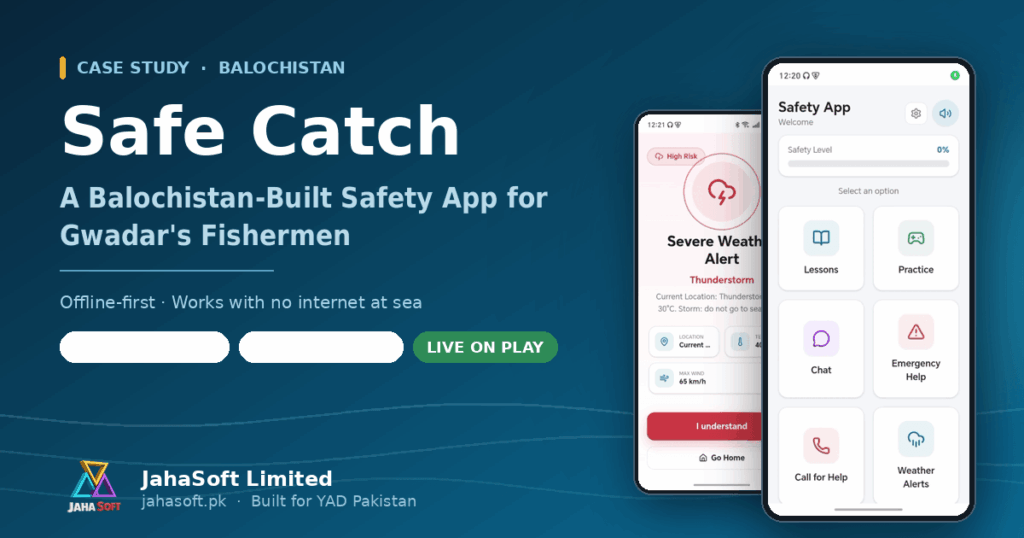
A fishing boat leaves Padi Zar at four in the morning. By seven it is far enough out that the mobile signal has gone. If the weather turns, nobody on shore knows. If the engine fails, there is no way to call for help. If someone goes over the side, the nearest boat might be a kilometre away and completely unaware.
This is normal on the Makran coast. It has been normal for generations.
Safe Catch is a mobile app built to change part of that. It is now live on the Google Play Store, developed by JahaSoft Limited in Quetta for the Youth Association for Development (YAD) Pakistan, with support from Lloyd’s Register Foundation, the UK safety charity. The pilot covers 50 small-scale fishermen in Gwadar District.
The whole thing was designed around one constraint: it has to work when there is no internet.
The problem Safe Catch was built to solve
Small-scale fishermen in Gwadar work in one of the more dangerous environments in Pakistan, with almost none of the safety infrastructure that larger commercial operators take for granted.
A few things stack up at once:
- Sudden weather. The Arabian Sea can shift from calm to dangerous within hours. Cyclone season brings real risk to open wooden boats.
- No reliable connectivity. Signal drops within a few kilometres of shore. Internet shutdowns happen on land too, which makes ordinary weather apps useless exactly when they are needed.
- No structured safety training. Most knowledge is passed down informally. That knowledge is valuable, but it was formed for a different climate and a different level of sea traffic.
- Low literacy. Any solution that requires reading paragraphs of Urdu or English will not be used.
- No direct line to authorities. There is often no practical way for a fisherman at sea to reach the Fisheries Department, the Maritime Security Agency, or a rescue service.
Standard safety apps assume a data connection, a literate user, and a modern phone. In Gwadar, none of those assumptions hold.
What Safe Catch actually does
Safe Catch is an Android app under 25 MB that runs on Android 7.0 and above. That size limit was deliberate. It has to install and run on the low-cost phones people in the fishing community actually own, not on a flagship device.
Everything below works with the phone in airplane mode, at sea, with zero bars of signal.
The SOS button
The main emergency control is a large button you press and hold for three seconds. The three-second hold prevents accidental triggering in a pocket.
When it fires, four things happen at the same time:
- An SMS goes out carrying the fisherman’s name, boat name and live GPS coordinates, plus a Google Maps link. This travels on a 2G signal — no data connection required.
- A loud alarm sounds from the phone speaker, repeating, so nearby boats can hear it.
- The camera flash blinks the international Morse code SOS pattern — three short, three long, three short — which is visible across open water at night.
- The app scans for nearby boats over Bluetooth and hands the alert to any it finds, so the message can hop from boat to boat until one of them has signal.
That last part matters more than it sounds. A fisherman with no signal at all can still get a message out, as long as one boat somewhere in the chain can reach a tower.
Weather-specific SOS buttons
Under the main SOS there are six smaller buttons, each matched to a weather condition: Sunny, Cloudy, Raining, Windy, Thunderstorm, and Severe Weather / Storm.
Tapping one sends a pre-written emergency SMS that describes both the distress and the conditions, with GPS location attached automatically. A rescue team that knows a boat is in trouble during a thunderstorm responds differently to one that knows the sea is calm. Nobody has to type anything.
Full-screen severe weather alerts
When dangerous weather is detected for the user’s location, the app does not wait to be opened. It takes over the entire screen with a red High Risk warning showing the hazard type, the location, the temperature and the maximum wind speed, and it plays a loud alert tone.
The instruction is written plainly. For a storm warning, it reads: do not go to sea today.
Weather you can check before leaving the jetty
The app pulls current conditions and a full seven-day forecast for the user’s exact location, with an hour-by-hour breakdown, wind speed, humidity, visibility, rain probability and a plain-language sea condition line.
Every forecast is downloaded and stored on the phone. Whenever the phone touches an internet connection — even for one minute at the harbour — the app quietly refreshes the whole seven days in the background. At sea, it shows the last saved forecast with a timestamp so the fisherman knows how current the information is.
Boat-to-boat chat with no network
The Chat screen uses Bluetooth to find other boats running Safe Catch within roughly 100 to 300 metres and lets them exchange messages directly, with no cell tower and no internet involved. Messages can relay across multiple boats.
Beyond emergencies, it reduces the isolation of long trips — which, spoken to enough fishermen, turns out to matter to them as much as the technical features do.
Emergency numbers and FM radio, pre-loaded
The app ships with the numbers already in it: PMSA Helpline 1331, PMSA MDRC, MERC 1122, and the Fisheries Department Balochistan. One tap dials.
It also displays the FM frequency for Radio Pakistan Gwadar — 98.0 MHz — which carries a daily five-minute safety bulletin at 8 AM. If the phone network fails entirely, an FM radio still works. Older technology, but it does not depend on anything that can be switched off.
Safety training in Urdu and Balochi
Alongside the emergency tools, Safe Catch carries a full training course built into the app: five modules covering Weather Safety, Boat & Equipment, Emergency Situations, Communication & Alerts, and Risk & Decision.
Each module contains short lessons, a decision scenario, and a quiz. A typical lesson is one screen: a large picture, one short sentence, and a speaker button. Tap the speaker and the app reads it aloud.
That speaker button is the most important design decision in the entire app. A fisherman who cannot read at all can complete the full training by listening and looking at pictures. All content is available in English, Urdu and Balochi.
The scenarios are where the training earns its place. One asks: strong wind is blowing — what will you do? You choose between going out and turning back, and the app tells you immediately, in your own language, whether that choice was safe and why. Getting it wrong on a phone screen costs nothing. Getting it wrong at sea costs everything.
Progress is tracked with a score and a safety level, which gives fishermen a reason to come back and finish the course rather than opening it once and forgetting it.
Why it matters that this was built in Balochistan
Plenty of development apps are designed in Islamabad, London or Nairobi by teams who have read a needs assessment about the community they are building for.
Safe Catch was built in Quetta by a team that has worked across Balochistan for years. That shows up in the details:
- The Balochi audio uses the Makrani dialect that fishermen in Gwadar actually speak, not a generic recording.
- The 25 MB size cap came from knowing which phones circulate in the coastal towns.
- The FM radio fallback exists because the team knew that signal loss on the Makran coast is routine, not an edge case.
- Sunlight readability was tested, because a screen that looks perfect in an office is unreadable on a boat deck at midday.
This is our fourth project with YAD Pakistan. We previously built their organisational website and the Hepatitis Connect awareness platform, which gave both teams a working relationship before this project started — useful when the requirements are unusual and the deadlines are real.
How to download Safe Catch
The app is free on the Google Play Store:
Download Safe Catch on Google Play
It can also be shared directly from phone to phone over Bluetooth or ShareIt, which is how it reaches fishermen who have no data connection to download from the store. YAD’s Safety Champions distribute it this way at the jetties.
The app collects no personal data and shares nothing with third parties. Progress is stored on the phone itself. Location is used only when the fisherman presses SOS or checks the weather.
What this means for other organisations in Pakistan
Safe Catch was a hard build. Offline-first architecture, SMS interception, Bluetooth mesh relay, trilingual audio and a strict size budget are not the standard ingredients of an NGO mobile app.
But the underlying problem is common across Pakistan. Any organisation working with communities in remote districts runs into the same wall: the field staff and beneficiaries do not have reliable connectivity, and most software quietly assumes they do.
If you are planning a project in health, agriculture, disaster response or education where the users will be offline for long stretches, the approach behind Safe Catch transfers directly. We work on mobile app development for exactly these conditions, and we hand over full source code and ownership on delivery.
Safe Catch was developed by JahaSoft Limited, a software company based in Quetta with registered entities in Pakistan, the United Kingdom and the United States. All source code and intellectual property for the application belongs to YAD Pakistan.
Safe Catch is a free Android safety app for small-scale fishermen in Gwadar, Balochistan. It provides emergency SOS alerts, offline weather forecasts, boat-to-boat messaging and safety training in Urdu, Balochi and English. It was developed by JahaSoft Limited for YAD Pakistan with support from Lloyd’s Register Foundation.
No. All training, the SOS system, the safety checklist and saved weather forecasts work fully offline. Internet is only used automatically in the background to refresh the seven-day forecast when a connection happens to be available.
The alert relays over Bluetooth from boat to boat until it reaches a phone with 2G coverage, which forwards it onward. The audio alarm and the Morse code camera flash work regardless of signal.
English, Urdu and Balochi. Every screen has a speaker button that reads the content aloud, so the app is fully usable by people who cannot read.
Yes. The offline-first architecture, multilingual audio system and SMS alert layer can be adapted for other regions, languages and sectors. Get in touch with JahaSoft to discuss requirements.