
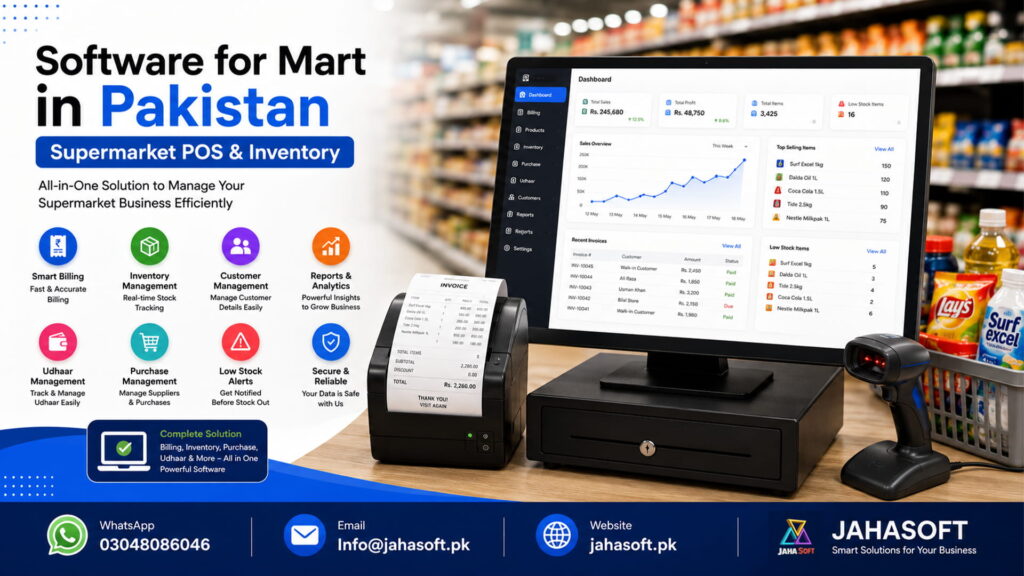
Mart software is a multi-counter retail system for supermarkets, departmental stores and cash-and-carry outlets. It runs several billing counters at once against one shared stock file, integrates weighing scales, tracks batches and expiry, controls shrinkage, handles promotions, and reports to FBR where the law requires it. The difference between mart software and general store software is scale and control: a mart has staff you cannot personally watch, and the software is how you watch instead.
The problem is not billing. It is leakage.
A mart owner rarely calls us because billing is slow. He calls because the numbers do not agree.
Purchases say one thing. Physical count says another. The gap is somewhere between the receiving door and the till, and nobody can point to it. In a shop with three counters, eleven staff and four thousand SKUs, that gap is not a rounding error. It is the margin.
Retail loss in a Pakistani mart usually comes from a handful of places, and every one of them is a record-keeping failure before it is anything else:
- Goods received are never counted against the delivery challan, so short deliveries are paid for in full
- Items expire on the shelf because nobody tracks batch dates
- Cashiers void or discount bills with no approval trail
- Loose items are weighed and priced by hand, differently by different staff
- Promotions run without anyone measuring whether they made money
- Nobody knows which of four thousand items are actually dead
Software will not make staff honest. What it does is make every movement leave a mark, which changes behaviour on its own.
What separates mart software from a general store system
If you run one counter and know every item personally, a general store system is enough. A mart needs more, and here is specifically what.
Multi-counter billing on one stock file
Three, five or ten counters bill simultaneously. All of them read and write the same live stock. Counter 2 cannot sell the last carton that Counter 4 just sold. Each cashier logs in with their own account, so every bill carries a name.
Weighing scale integration
Loose vegetables, fruit, meat, rice, pulses. The scale talks to the POS directly and the weight becomes the price without anyone typing. This kills a whole category of error and dispute, and it speeds up the queue on Friday evening.
Batch, lot and expiry control
Dairy, bakery, frozen, packaged food, cosmetics, over-the-counter medicine. Every batch carries its own expiry. The system flags items entering their last thirty days so you clear them at a discount rather than write them off. FIFO enforcement means the older batch sells first.
Goods receiving that matches the challan
The receiving screen sits between the supplier’s delivery and your stock. Someone counts, enters, and any short or damaged quantity is recorded against the supplier before payment. Supplier claims become a report, not an argument.
Shrinkage and audit trail
Every void, every price override, every discount, every stock adjustment is logged with a user, a time and a reason. Cycle counting lets you count one category a week instead of shutting the mart for a full stocktake. Variance reports show you where the loss sits.
Promotions and loyalty
Buy-one-get-one, bundle pricing, category discounts, time-limited offers, Ramzan and Eid campaigns. Then a report telling you whether each campaign made or lost money, which is the part most systems skip. Customer loyalty with points and a purchase history feeds into our CRM work.
Multi-branch and central warehouse
Two branches or twenty, one dashboard. Central purchasing, branch-level stock, inter-branch transfers with proper transfer notes, branch-versus-branch performance. Once you get to this size, you are no longer buying POS. You are buying ERP, and it should be scoped that way from the start.
Accounting that closes the loop
Sales, purchases, expenses, supplier payables, customer receivables, bank and cash, then a profit and loss you can trust. We build this properly rather than exporting to a spreadsheet someone maintains by hand. See our accounting software and inventory management system pages.
Offline mode, because this is Pakistan
A mart with five counters cannot stop billing because the internet dropped. Our systems bill locally and sync to cloud when the connection returns. We have done this repeatedly, including for Murky Nexus Ice Factory and a battery distribution business.
FBR POS integration: marts are the ones this actually hits
If you run a mart, read this section properly. This is where kiryana shops and marts genuinely differ under the law.
FBR requires Tier-1 retailers to integrate their point of sale with FBR’s system, so every sale is reported in real time and the receipt carries an FBR invoice number and a verifiable QR code. Under the Sales Tax Act, 1990 and FBR notifications, a retailer is generally Tier-1 if any of these apply:
- It operates as a unit of a national or international chain of stores
- It operates in an air-conditioned shopping mall, plaza or centre (kiosks excluded)
- It has a credit card, debit card or other electronic payment machine
- Its cumulative electricity bill exceeded Rs 1.2 million over the preceding twelve months
- It is a wholesaler-cum-retailer importing consumer goods in bulk and supplying both to retailers and to end consumers
- It has paid advance withholding tax above the thresholds under sections 236G or 236H of the Income Tax Ordinance, 2001
Most marts of any size meet at least one of these. An air-conditioned departmental store with a card machine is comfortably inside the definition.
Retailers who integrate also carry ongoing obligations, including keeping POS running at every payment counter and reporting failures, tampering or disruption to the Commissioner Inland Revenue within twenty-four hours.
Two practical notes. First, verify your own status with a tax advisor and against FBR’s published criteria, since thresholds and notified sectors have been expanding. Second, if you are buying software this year, buy something that can integrate whether or not you need it today. Retrofitting compliance into a system that was never designed for it is the expensive path.
We build FBR-ready systems. If you already have software and only need the integration layer, we can quote that separately.
Beyond the mart itself
A mart with software has data, and data opens doors that a register never did.
Sell online. Home delivery inside your city, running off the same stock file so the website never sells what the shelf does not have. We build ecommerce sites in Quetta, including Shopify stores. A worked example is Star Electric Quetta, where we took a physical retailer online.
Get found. Being on Google when someone in your city searches for what you sell is worth more than most billboards. See SEO services in Quetta and ecommerce development with SEO.
Mobile app for the owner. Live sale, live cash, live stock alerts, from wherever you are. Part of our mobile app development work.
Loyalty and repeat customers. Once you know who buys what and how often, targeted offers stop being guesswork.
Who we build mart systems for
Independent marts and departmental stores. The core case. Multi-counter, staff permissions, promotions, FBR-ready.
Chains and franchises. Central control, branch autonomy, consolidated reporting.
Cash and carry, wholesalers, distributors. Party rate lists, credit terms, delivery challans, area-wise sales, recovery tracking. Our fertilizer dealer and dry fruit trading systems cover this ground.
Institutional and government stores. CSD-style welfare stores, university and hospital canteens, cooperative societies, departmental supply stores. These need indent workflow, approval chains, department-wise consumption and audit-grade reporting. We build to specifications that pass audit rather than to what looks good in a demo.
NGOs and relief organisations. Ration distribution points and project stores need beneficiary records, distribution logs and donor reporting. We have done this kind of work for YAD Pakistan, including YAD Cloud on AWS, and written about digitising NGOs in Balochistan.
Manufacturers with retail outlets. Production plus retail on one system. See software for a cake manufacturing factory.
A multi-counter retail management system for supermarkets, departmental stores and cash-and-carry outlets. It runs several billing counters against one live stock file, integrates weighing scales, tracks batches and expiry, controls shrinkage through an audit trail, manages promotions and loyalty, and handles FBR digital invoicing where required.
Scale and control. A general store system is built for one counter and an owner who knows every item. Mart software adds simultaneous multi-counter billing, staff permissions, weighing scale integration, batch and expiry tracking, goods-receiving against challans, promotion analysis, multi-branch consolidation and a full audit trail.
Not with an offline-first system. JahaSoft builds mart software that bills locally and syncs to the cloud when connectivity returns, so counters keep running during load shedding and ISP outages. Cloud-only systems will stop.
Yes. Each branch bills against its own stock while head office sees consolidated sales, stock and profit, with inter-branch transfers tracked and branch-versus-branch comparison reports.
Yes. Party-wise rate lists, credit terms, delivery challans and recovery tracking sit alongside the
Yes. We build indent and approval workflows, department-wise consumption reporting and audit-grade records. JahaSoft is UNGM-registered and has delivered donor-funded systems for NGOs in Balochistan.