
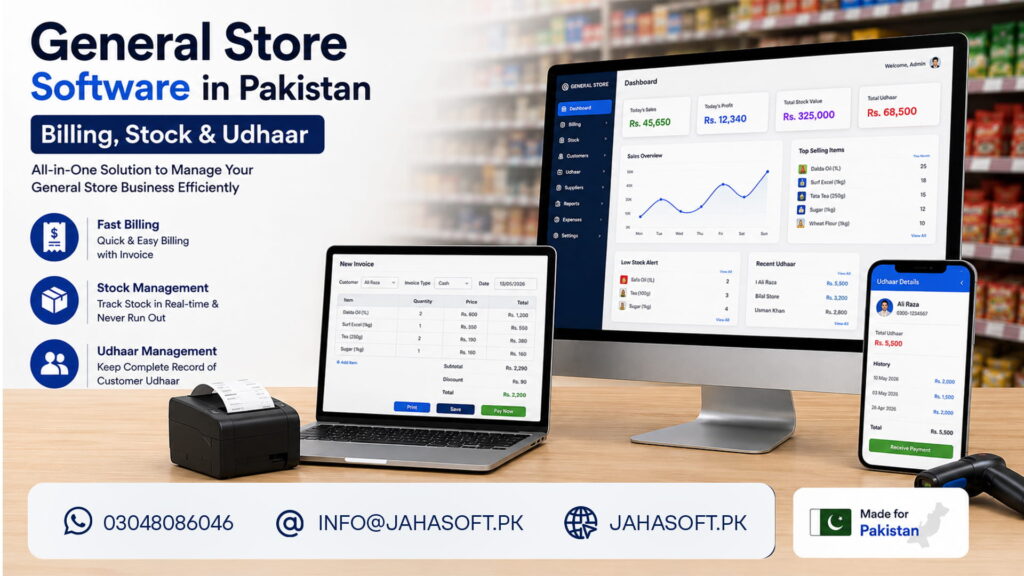
General store software is a billing and stock system for kiryana and grocery shops. It scans a barcode, prints the bill, subtracts the item from stock, records who owes you money, and tells you at closing time what you sold and what you earned. A good one keeps working when the electricity and the internet do not. JahaSoft Ltd builds these systems from Quetta for shops across Pakistan, and we build them offline-first because that is what actually happens here.
The register is costing you more than you think
Most general store owners we meet in Quetta are not disorganised. They are doing three jobs at once with a pen.
The register tracks udhaar. A separate copy tracks daily sale. Purchases live in the supplier’s bill book, which is in a drawer somewhere. Stock lives in the owner’s head, which works fine until he travels for two weeks and the shop runs out of ghee and cooking oil on the same Friday.
What that costs, in our experience with shops in Suraj Ganj Bazaar and Liaquat Bazaar:
- Udhaar that quietly dies. Every shop has customers who stopped coming. Nobody knows exactly how much walked away because nobody totalled the register.
- Dead stock. Items sitting for eight months because no one noticed they were not moving.
- Stockouts on your best sellers. The items that pay your rent go missing on the busiest day.
- Staff theft you cannot prove. Not accusing anyone. But when there is no record of what came in, there is no record of what left.
- Purchase price amnesia. You remember the selling price. You do not remember what you paid three months ago, so you have no idea what your actual margin is.
None of that is a discipline problem. It is a record-keeping problem, and software fixes record-keeping problems.
What general store software actually needs to do
Half the systems sold in Pakistan are foreign products with the labels changed. They assume steady electricity, an accountant on staff, and customers who pay cash on the spot. That is not a kiryana shop.
Here is what we build into a general store system for Pakistani conditions.
Barcode billing at the counter
Scan, scan, total, print. A cashier should learn it in twenty minutes without reading anything. For loose items like rice, sugar, daal and cooking oil, the system takes weight or quantity and prices it correctly. We generate and print barcode labels for items that arrive without them, which in a general store is most of them. If you want to see the standalone tool we built for label and QR generation, look at eBarcode.
Udhaar khata that adds itself up
This is the feature owners ask about first, and most international POS products handle it badly because credit-to-walk-in-customers is not a normal Western retail concept.
Every customer gets a ledger. Sales on credit attach to it. Payments knock it down. You open one screen and see who owes what, sorted by how old the balance is. We can push a WhatsApp reminder with the running balance, which recovers money without anyone having an awkward conversation.
Stock that warns you before it runs out
Set a minimum level per item. When a fast-moving item drops to it, the system flags it. At the end of the month you get a list ranked by units sold, so you order more of what sells and stop reordering what does not.
Purchase and supplier records
Every delivery gets entered against the supplier with the rate you paid. Now you have purchase history, supplier balances, and a real margin figure per item instead of a guess. Our inventory management system work covers this in more depth.
Expiry and batch tracking
Milk, bread, yoghurt, medicines, packaged snacks. The system tracks batches and warns you before things expire, so you discount them while they are still sellable instead of throwing them out.
It works when the power goes
This is the part that decides whether software survives in a Pakistani shop. If your billing system needs internet, then a PTCL outage or a WAPDA fault means no billing. In Quetta and most of Balochistan, that is not an edge case. It is Tuesday.
We build offline-first. Data lives on the machine at your counter. Billing does not stop. Cloud sync runs in the background whenever a connection appears. We have written up how we did this for two clients, one an ice factory and one a battery distributor: offline-first web app for Murky Nexus Ice Factory and battery management software that works online and offline.
Reports you will actually open
Daily sale, daily profit, cash in the drawer versus cash recorded, top twenty items, dead stock, outstanding udhaar. On your phone, so you can check the shop from anywhere. If your accounting needs go further than this, we also build proper accounting software that ties into the same data.
If you run one counter selling standard packaged goods, a subscription product may serve you well. Go and try one.
Custom makes sense when your shop does something a generic product cannot express: you supply a canteen on monthly account, you sell wholesale and retail from the same stock, you run two shops with one warehouse, you deal in a category with its own units and rules. That is where we usually get called. A worked example is Hassani Traders, where we unified a multi-branch trading business from Barech Market to Panjgur on one platform with multi-currency support.
Who this is for
Kiryana and general stores. One counter, one owner, ten to two thousand items. The base system.
Grocery shops and mini marts. Multiple counters, staff accounts, permissions so a cashier can bill but cannot edit prices or delete a bill.
Wholesalers and distributors. Batch and lot tracking, party-wise rate lists, delivery challans, area-wise sales, recovery reports. If you sell to shops rather than to consumers, the credit and recovery side matters more than the counter speed. Our work with fertilizer dealers and pesticide and agri-input shops is built around exactly that.
Specialist retail. Dry fruit, stationery, cosmetics, hardware, auto parts. Same core, different units and categories. See our dry fruits inventory solution and stationery shop software.
NGOs and welfare organisations. If you run a subsidised ration store, a relief distribution point, or a project store, you need stock control plus an audit trail your donor can inspect. We built donor-grade reporting into work for YAD Pakistan, including YAD Cloud, and we have written about digitising NGOs in Balochistan.
Government departments, cooperatives and institutional stores. University tuck shops, hospital canteens, army and police welfare stores, cooperative societies. These need issue notes, department-wise consumption, indent approval, and reports that survive audit. We build to that standard.
The tax question: does FBR apply to your shop?
Most single-counter kiryana shops are not Tier-1 retailers, so mandatory FBR POS integration does not apply. But you should know where the line sits, because crossing it is not always obvious.
Under the Sales Tax Act, 1990 and FBR notifications, a retailer is generally Tier-1 if any of these are true:
- It operates as a unit of a national or international chain of stores
- It operates in an air-conditioned shopping mall, plaza or centre (kiosks excluded)
- Its cumulative electricity bill exceeded Rs 1.2 million over the preceding twelve months
- It is a wholesaler-cum-retailer importing and supplying consumer goods in bulk
- It has paid advance withholding tax above the thresholds set under sections 236G and 236H of the Income Tax Ordinance, 2001
If you are near any of these, check with a tax advisor and check FBR’s own criteria before assuming you are exempt. Systems we build can be prepared for FBR digital invoicing so that if your shop grows into Tier-1, you are not rebuilding from scratch.
What it costs
Honest answer: it depends on scope, and anyone giving you a firm number before understanding your shop is guessing.
The variables are the number of counters, the number of branches, whether you need Urdu, whether you need a mobile app for the owner, whether you need FBR integration, and how unusual your workflow is. A single-counter general store system is a very different project from a distributor with four branches and a warehouse.
What we do is a free scoping call. You tell us how the shop runs, we tell you what it would take and what it would cost, in writing, before you commit to anything. Our article on what a website costs in Quetta explains how we price work generally.
How the project runs
- Talk. Phone, WhatsApp or a visit to your shop. We watch how you bill, how you record udhaar, how you order stock.
- Written scope. Features, screens, timeline, price. Nothing starts until you sign it.
- Build. You see working screens as we go, not at the end.
- Data entry. We help load your item list, rates and opening balances.
- Training. In Urdu, at your counter, with your staff, on your data.
- Support. Phone and WhatsApp. Real people in Quetta, not a ticket queue in another time zone.
Read how to choose a software house in Quetta before you hire anyone, including us. It lists the seven things worth checking.
About JahaSoft
JahaSoft is a registered software company with three entities: JahaSoft Ltd in the UK (Companies House No. 14653641), JAHASOFT (SMC-PRIVATE) LIMITED in Pakistan (SECP CUIN 0144811, registered at the Quetta CRO), and JahaSoft LLC in Texas. Head office in Quetta, Balochistan, with registered offices in Wolverhampton and Austin.
We have been building custom software since 2020 for NGOs, SMEs, wholesalers and international clients. We are UNGM-registered. Our work runs from a maritime safety app for Gwadar fishermen funded by the Lloyd’s Register Foundation to towing management platforms in Canada. More at best software house in Quetta and IT company in Balochistan.
A billing and stock system for kiryana and grocery shops. It handles barcode billing, tracks inventory, records customer credit, manages suppliers, and produces daily sale and profit reports. It replaces the register and the calculator.
Yes, if it is built that way. JahaSoft builds offline-first systems where data lives on the counter machine and billing continues during power cuts and internet outages. Cloud backup syncs whenever a connection returns. Cloud-only systems stop working during outages, which is worth checking before you buy.
Usually not. FBR POS integration is mandatory for Tier-1 retailers, defined under the Sales Tax Act, 1990. Most single-counter general stores fall outside that. If your shop is in an air-conditioned plaza, is part of a chain, or your annual electricity bill exceeds Rs 1.2 million, check with a tax advisor. Our systems can be built FBR-ready either way.
Yes. Full Urdu or a bilingual Urdu and English interface, so counter staff do not need English to bill.
Yes. Multi-branch means each shop bills independently with its own stock, while the owner sees combined figures. Stock transfers between branches are tracked.
Yes. We build an owner dashboard showing today’s sale, profit, cash position and stock alerts, accessible from anywhere.
es. We work with clients across Pakistan and internationally, with remote onboarding, training and support. On-site setup is available in Quetta and across Balochistan.
We migrate item lists, customer balances and supplier records from Excel, from most existing POS products, and from handwritten registers.