
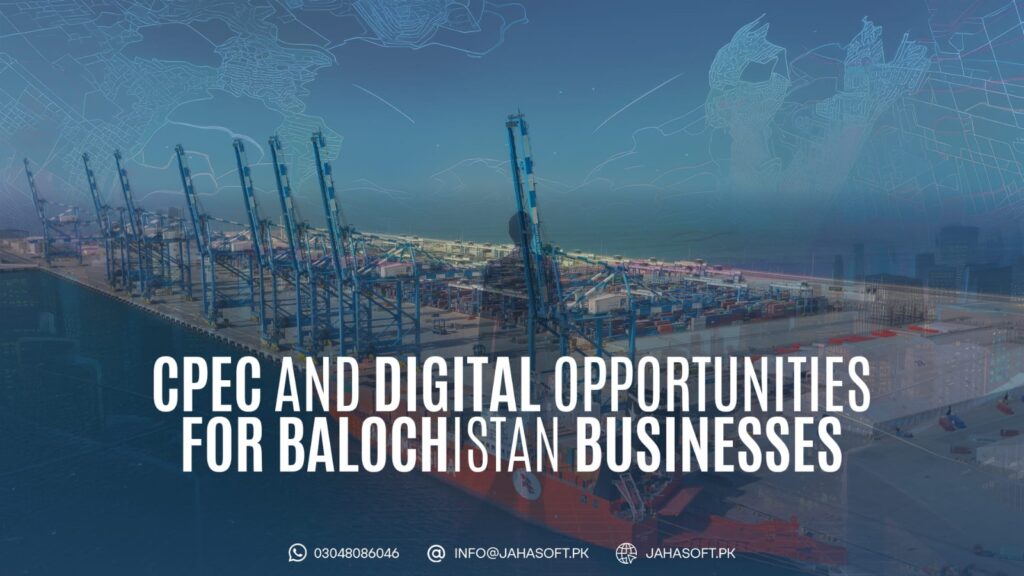
Balochistan is having a moment that the rest of Pakistan is only beginning to understand. The province that holds roughly 75% of the country’s mineral wealth, anchors the deep-sea port at Gwadar, and sits at the geographic heart of the China-Pakistan Economic Corridor (CPEC) is no longer just a map of pipelines and highways. As CPEC enters its second phase, the conversation is shifting from concrete and cargo to code, cloud, and connectivity — and that shift is exactly where Balochistan’s businesses stand to win.
At JahaSoft Limited, we work at that intersection every day: helping shopkeepers in Quetta, traders near Gwadar, schools across the province, and exporters with global ambitions turn the CPEC growth story into real digital advantage. This guide explains where the opportunities are, what’s changed in 2025–2026, and how local businesses can position themselves before the window narrows.
CPEC 2.0: From Hardware to Digital Depth
The first decade of CPEC was about “early harvest” — roads, power plants, and the physical bones of an economy. By 2026 the priorities have visibly changed. CPEC’s second phase is pivoting toward Special Economic Zones, agriculture, minerals, and information technology — a deliberate move from hardware to economic depth.
The numbers behind that pivot are striking. For fiscal year 2025–26, the federal government allocated a record Rs 205.99 billion (roughly US$739 million) to Balochistan under the Public Sector Development Programme — close to 68% of the combined federal development pool — and by March 2026 over Rs 73 billion had already been disbursed across nearly 150 active projects spanning roads, water, power, and education. The New Gwadar International Airport opened in January 2025, and the Gwadar Free Zone together with the nearby Hub Special Economic Zone had attracted around US$2.4 billion in committed investment by early 2026.
Here’s why that matters for a digital business: every new factory in a Special Economic Zone needs inventory and accounting systems. Every trading firm clearing goods through Gwadar needs digital invoicing and logistics tracking. Every new school built under the development programme needs management software. Physical infrastructure creates demand for digital infrastructure — and the businesses that build, sell, and support that software locally are the ones who capture the value instead of importing it.
Balochistan’s Digital Moment, By the Numbers
The provincial story sits inside a national surge that is impossible to ignore. Pakistan’s IT and IT-enabled services exports reached roughly US$3.8 billion in the first ten months of FY2025–26, growing about 21% year-on-year, and for the first time crossed 10.8% of the country’s total exports. Freelancer earnings alone jumped to US$856 million in the first nine months of the fiscal year — up around 50% — with the national freelance workforce now exceeding 2.37 million people. Pakistan was named “Tech Destination of the Year” at GITEX Global in 2024, and the federal “Uraan Pakistan” plan targets doubling national exports toward US$60 billion by 2029 with digital transformation as a central pillar.
Balochistan is plugging into that current. During 2025, the Universal Service Fund completed broadband connectivity projects reaching districts including Gwadar, Kech, Awaran, and Khuzdar, narrowing the rural internet gap. Quetta’s first Tech Park was established through a public-private partnership, and skills networks such as the Digital Transformation Awareness Network now train tens of thousands of young people each year in web development, digital marketing, e-commerce, and freelancing. The talent and the connectivity are arriving at the same time as the capital — a rare alignment.
Seven Digital Opportunities for Balochistan Businesses
The CPEC era rewards businesses that can sell beyond their street, run lean operations, and look credible to clients and partners they will never meet in person. Below are the seven openings we see most clearly from the ground in Quetta and across the province.
1. Sell beyond the province with e-commerce
A shop in Quetta or Turbat is limited by who walks through the door. An online store is not. As payment infrastructure and logistics improve along the corridor, local manufacturers, dry-fruit and handicraft sellers, and retailers can reach customers in Karachi, the Gulf, and beyond. A professionally built e-commerce website turns a local brand into an exportable one — and e-commerce is precisely the high-value digital activity the national strategy is pushing.
2. Make distance irrelevant with cloud
Balochistan is vast, and businesses with operations split between Gwadar, Quetta, and other towns lose time and money to fragmented systems. Moving data, email, and applications to the cloud means a single source of truth accessible from any site, automatic backups, and the ability to scale without buying servers. Our cloud solutions are built for exactly this reality, including connectivity that is improving but still uneven.
3. Modernise retail and trade with a smart POS
As consumer activity rises around CPEC corridors and Gwadar’s growing population, cash-only counters leave money and insight on the table. A modern POS system handles sales, receipts, multi-branch reporting, and tax-ready records in real time, giving owners the visibility they need to grow rather than guess.
4. Control logistics and stock with inventory management
The corridor is, at its core, a logistics story — goods moving from the port inland and from the province outward. Distributors, wholesalers, and traders who still track stock on paper cannot compete at that pace. An inventory management system reduces dead stock, prevents shortages, and ties directly into sales and accounting, turning a warehouse into a managed asset.
5. Stay compliant and bankable with proper accounting
Access to low-interest credit through programmes such as the Balochistan SME Support initiative depends on clean, verifiable financials. Banks and investors fund businesses they can read. Reliable accounting software keeps books audit-ready, automates tax reporting, and makes a company far more fundable when CPEC-linked opportunities arrive.
6. Digitise the education sector
Development spending is pouring into schools across Balochistan, and education is one of the fastest-digitising sectors in the province. Institutions that adopt school management software — handling admissions, attendance, fees, results, and parent communication — run more transparently and serve more students with the same staff, which is exactly what funders want to see.
7. Earn trust with strong UI/UX and design
When buyers in Dubai, London, or Lahore can’t visit your office, your digital presence is your office. Clean, intuitive UI/UX design is the difference between a website that converts international clients and one they bounce from. For a province working to overcome perception gaps, professional design is not cosmetic — it is competitive armour.
The Challenges Worth Naming Honestly
A credible opportunity piece doesn’t pretend the path is frictionless. Balochistan still faces a real digital divide: rural connectivity remains patchy, internet and mobile suspensions have disrupted online work during security incidents, and the province’s literacy and digital-skills base lags the national average. CPEC projects themselves have faced delays and security pressures.
None of this cancels the opportunity — it shapes how to pursue it. The right approach is resilient systems (cloud setups that tolerate intermittent connectivity, offline-capable POS and inventory tools), investment in local skills, and a digital partner who understands provincial conditions rather than applying a Lahore or Karachi template. That practical, ground-aware mindset is the whole point of working with a team rooted in the region.
Why JahaSoft Limited Is Balochistan’s Digital Partner
JahaSoft Limited is registered in Pakistan, the United Kingdom, and the United States, and we have served more than 1,000 clients internationally — not only across Pakistan but around the world. That global footprint is matched by local roots in Quetta and a deep understanding of how business actually works in Balochistan.
Our track record shows in our reputation: hundreds of reviews across Google Business Profile and other marketplaces, all carrying 5-star ratings. That consistency reflects the trust clients place in us and the results they get — the same combination of reliability, transparency, and follow-through that CPEC-era growth demands.
If you’re a Balochistan business ready to turn the CPEC growth story into a digital advantage, we’re ready to help with a quick response:
- WhatsApp / Call (US): +1 (512) 202-0411
- WhatsApp / Call (Pakistan): +92 304 8086046
- WhatsApp / Call (UK): +44 7803 707311
The Window Is Open Now
The infrastructure is being laid, the capital is arriving, the talent is being trained, and connectivity is reaching further into the province than ever before. CPEC’s pivot toward IT and Special Economic Zones means the next decade of Balochistan’s growth will be decided as much in code as in concrete. The businesses that digitise early — selling wider, running leaner, and looking credible to the world — will be the ones that lead. JahaSoft Limited is here to build that future with you.
CPEC is the China-Pakistan Economic Corridor, a multibillion-dollar connectivity and investment programme. Balochistan is central to it because it hosts Gwadar Port and holds an estimated 75% of Pakistan’s mineral wealth. As CPEC’s second phase shifts toward Special Economic Zones and IT, local businesses gain new markets, supply-chain demand, and a strong reason to digitise.
Very fast. National IT and IT-enabled exports reached around US$3.8 billion in the first ten months of FY2025–26, up roughly 21% year-on-year, while freelancer earnings rose about 50% to US$856 million in nine months. IT now makes up more than 10% of Pakistan’s total exports.
Most small businesses get the fastest return from a POS or accounting system to control daily operations, followed by an e-commerce store or website to expand reach. The right starting point depends on your sector — JahaSoft can recommend a sequenced plan after a quick consultation.