
Walk into any hardware or sanitary shop on Suraj Ganj Bazaar, Mission Road, Sabzal Road, or Brewery Road and you’ll see the same scene. A thick register on the counter. Loose slips under a paperweight. A worker shouting from the back godown asking whether the 4-inch PPRC elbows are finished or not. And somewhere in the middle of it all, the owner trying to remember whether Ustad Rahim paid last month’s Rs. 84,000 or only half of it.
The business is running. The profit is real. But nobody can see it clearly.
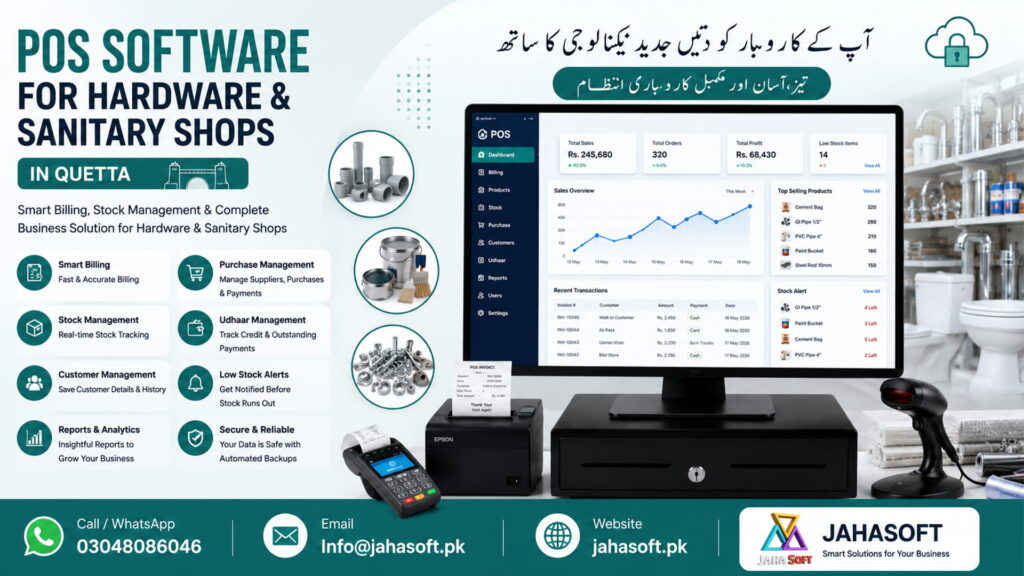
That’s the problem POS software solves — not by adding complexity, but by removing guesswork. JahaSoft Ltd builds POS and inventory systems specifically for hardware, sanitary, paint, tiles, and construction material shops across Quetta and Balochistan. Not a generic retail app downloaded from the internet, but a system that understands how your shop actually trades.
Why Generic POS Software Fails in a Hardware Shop
Most billing software on the market was designed for a grocery store or a pharmacy. Scan a barcode, add to cart, print receipt, done. That model breaks the moment it enters a hardware shop, because your inventory doesn’t behave like packets of biscuits.
Here’s what actually happens on your counter every day:
One item, three different units. Sariya sells by ton to a contractor, by kilogram to a small buyer, and by piece to a walk-in customer. Paint moves in drums, gallons, and quarters. Wire goes out by coil or by meter. Pipes are measured in feet, sold in full lengths. A normal POS has one unit field. Your business needs a conversion engine.
Prices that move week to week. Cement and steel rates in Quetta shift with the market, with transport costs from Karachi, and with the season. Software that locks you into a fixed price list is useless. You need last-purchase-rate visibility, brand-wise costing, and the ability to update rates in seconds before a customer walks in.
Half your sales are on credit. Contractors, masons, builders, and regular customers buy on udhaar. That ledger is the single biggest source of loss in hardware retail — not theft, not damage, just forgotten and undocumented credit. Written in a register, it’s a memory test. In software, it’s a report.
No barcodes on most items. Nobody barcodes a bag of nails or a bathroom trap. Your system needs fast keyboard search, item codes, and category shortcuts — not a scanner-only workflow.
Stock lives in more than one place. Shop front, back godown, sometimes a separate store on Airport Road or a warehouse in Kuchlak. If your software can’t separate them, your stock report is fiction.
A hardware POS that ignores these realities gets abandoned within two weeks. That’s exactly why we build ours differently.
What JahaSoft’s Hardware & Sanitary POS Actually Does
1. Multi-Unit Billing That Matches How You Sell
Define a parent unit and its child units once — ton, bag, kg, piece, foot, box, gallon — and the system handles conversion automatically. Sell 3 tons to a builder in the morning and 12 kg to a walk-in at noon; your stock reduces correctly both times.
2. Udhaar Khata With Real Accountability
Every credit customer gets a digital ledger. Opening balance, every bill, every partial payment, every return. You can see who owes what, how long it’s been outstanding, and who’s crossing their credit limit — before you hand over more material. Print or WhatsApp a statement in one click when it’s time to recover.
3. Brand-Wise and Batch-Wise Stock Control
Lucky, Fauji, Askari, Attock — cement isn’t one product, it’s several. Same with sariya grades, tile shades, and sanitary brands. The system tracks each SKU separately with its own purchase rate, sale rate, and stock level, so your margin per brand is visible instead of averaged into nothing.
4. Purchase, Supplier and Rate History
Record every supplier bill. The system remembers what you paid last time for the same item from the same supplier — so when a rate quietly creeps up, you notice. Supplier payables are tracked the same way customer receivables are.
5. Works Offline During Load Shedding
This matters in Quetta more than in most cities. Our desktop POS builds run fully offline on a local machine, syncing to cloud when connection returns. No internet, no problem — billing continues.
6. Quotations, Delivery Challans and Gate Passes
Contractors ask for quotations before ordering. Material leaves the shop on a challan before the invoice is settled. The system produces all of it on your letterhead, numbered and traceable.
7. Damage, Return and Breakage Handling
Sanitary ware breaks. Tiles crack. Cement hardens. Record it properly so your stock report and your profit report both stay honest.
8. Reports That Answer Real Questions
Daily cash summary. Item-wise profit. Dead stock sitting for 90 days. Top customers. Total outstanding udhaar. Salesman-wise performance if you have staff on the counter. Reports you’ll actually open, not fifty you’ll ignore.
9. Urdu Support and a Simple Interface
Your counter staff isn’t a software engineer. Screens are built for speed and clarity, with Urdu labelling available where it helps. Training takes hours, not weeks.
Who This Is Built For in Quetta and Balochistan
- Hardware shops and general hardware stores
- Sanitary ware and bathroom fittings showrooms
- Cement, sariya and construction material dealers
- Paint and chemical dealers
- Tiles, marble and flooring retailers
- PVC, PPRC and pipe fitting suppliers
- Electrical goods and wiring shops
- Tools, machinery and equipment traders
- Multi-branch traders operating between Quetta, Chaman, Pishin, Mastung, Khuzdar, Sibi, Loralai, Zhob, Turbat and Gwadar
If your business sits anywhere in this chain — importing, wholesaling, or retailing building material — the system adapts to your workflow rather than forcing you into someone else’s.
Local Experience Is the Difference
JahaSoft Ltd has been building software from Quetta since 2020, with company registrations in Pakistan, the United Kingdom and the United States, and more than 1,000 clients served internationally. But the reason hardware traders in Balochistan choose us is simpler than that: we’re here.
We understand seasonal construction cycles in Balochistan. We know how material moves from Karachi port up the RCD highway. We’ve built systems that handle multi-currency purchasing for traders importing through Iran and Afghanistan borders. And when something breaks, you’re calling a team in Satellite Town — not a support ticket queue in another country.
We’ve already delivered POS and management systems for pharmacies, supermarkets, restaurants, ice factories, dairy farms, pesticide dealers, stationery shops, and electronics retailers across the region. Hardware and sanitary is a natural extension of that work.
If you’re comparing options first, our guide on the best POS billing software for small businesses in Quetta breaks down what to look for. For businesses whose main headache is stock rather than billing, our inventory management system in Quetta page covers warehouse-level control in more depth. And for a broader look at our retail platform, see our main POS system in Quetta page.
Deployment: How We Get You Running
Step 1 — Free consultation. We visit your shop or speak on WhatsApp. We look at how you currently bill, where your stock sits, and how your udhaar is managed.
Step 2 — Requirement sheet. We write down exactly what your shop needs: units, categories, branches, user roles, report formats. You approve it before development starts.
Step 3 — Configuration and data entry. Your item list, opening stock, customer balances, and supplier records are loaded in. This is where most shops get stuck alone — we handle it with you.
Step 4 — Installation and training. Desktop, cloud, or both. Your staff is trained on the counter, in your shop, on your data.
Step 5 — Support. Ongoing help, updates, and changes as your business grows. Adding a second branch later doesn’t mean starting over.
Most hardware shop deployments go live within one to three weeks depending on catalogue size.
What It Costs
Pricing depends on three things: number of counters or users, whether you need offline desktop or cloud access, and how many branches or godowns you’re tracking. A single-counter hardware shop is a very different build from a three-branch cement and steel distributor.
We quote per project after understanding your shop, and we quote in writing. No hidden module charges. Contact us for a free assessment and a fixed-price proposal.
Ready to Get Your Hardware Shop Organised?
Stop guessing your stock. Stop losing money on forgotten udhaar. Get a system built for how hardware and sanitary shops in Quetta actually trade.
JahaSoft Ltd
📱 WhatsApp: +92 304 8086046
📧 Email: Info@jahasoft.pk 📍
Address: Satellite Town, Block #3, Quetta, Pakistan
Message us on WhatsApp with the name of your shop and we’ll arrange a free consultation — in person if you’re in Quetta, or on call anywhere in Balochistan.
Yes. Multi-unit conversion is a core feature. You set the relationship once — for example 1 ton equals 1,000 kg — and the system converts automatically at billing, keeping stock accurate no matter which unit the customer buys in.
Yes. We offer offline-first desktop builds that run entirely on your local computer. Billing, stock, and udhaar all continue working without internet. When your connection returns, data syncs to the cloud if you’ve chosen a cloud-enabled setup.
Yes. The system supports multiple locations. Stock in your shop on Mission Road and stock in a godown in Kuchlak are tracked as separate stores, with transfer entries between them. Consolidated and location-wise reports are both available.