
Most guest houses lose room service orders the same way. A guest wants tea and a club sandwich at 9pm, picks up the intercom, nobody answers, and they give up. The kitchen never hears about it. The owner never sees the missing revenue, because there is no record of an order that was never placed.
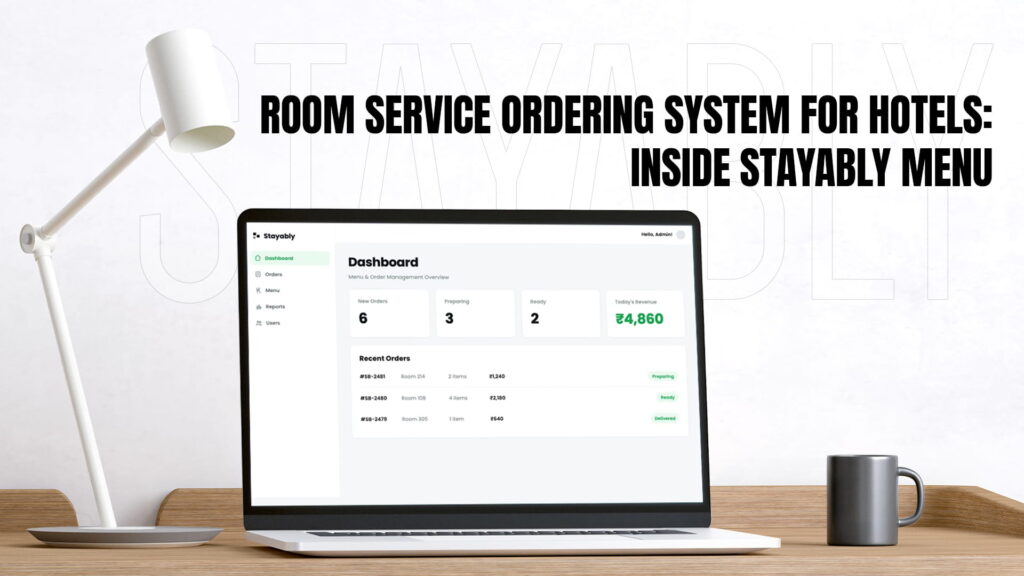
Stayably Menu closes that gap. It is a room service ordering system that lets a guest order from their own phone, with no app to install and no trip to the front desk. Every order lands on a single live dashboard where staff move it from received to delivered in a tap.
We built it for Stayably, a client we had already delivered a full property management system to. That original build handles day-by-day rentals for guest house owners, automated payment links, and WhatsApp messaging with guests. Menu is the piece that sits on top of it.
Here is the walkthrough video if you would rather watch than read:
https://www.youtube.com/watch?v=oQfry-id-2o
What a room service ordering system actually needs to do
Strip away the marketing and there are four jobs:
- Let the guest browse a current menu and place an order in under a minute.
- Prove the person ordering is actually staying in that room.
- Put the order in front of the kitchen and front desk at the same moment.
- Tell the owner, later, what sold and what did not.
Plenty of software does one or two of these. The awkward part is the second one, and it is where most hotel ordering tools either get annoying or get sloppy.
Sign-up is one phone number, checked against the reservation
We did not want a registration form. Name, email, password, confirm password, verify email, then order a paratha. Nobody is doing that from bed.
A guest enters their phone number. The system checks it against the reservation on file for that room. If it matches, they are in. If it does not, they are not, and the kitchen never sees a prank order from someone who walked past the gate.
This works because the booking data is already in the Stayably system. The reservation is the identity check. Nothing extra to maintain, no room-key codes to reprint, no separate guest database drifting out of sync.
One live dashboard, four states
Staff see every open order in one place, sorted by status: new, preparing, ready, delivered. A ticket moves forward with a tap.
That sounds simple, and the simplicity is deliberate. In a small guest house, the person taking the order, the person cooking, and the person carrying the tray are often two people or one. A dashboard with fifteen columns and a permission matrix would sit unused. Four states and a big tap target get actually used at 11pm.
Revenue updates on the same screen as orders close, so the front desk knows what the shift has done without opening a report.
The owner runs the menu, not us
Every menu change going through a developer is how software dies. Owners stop bothering, the menu goes stale, guests order things the kitchen ran out of two weeks ago.
So the menu is fully in the client’s hands:
- Add or remove dishes
- Change prices whenever they want
- Tag items vegetarian, gluten-free, or whatever their guests ask about
- Pull an item for the night when the kitchen runs out, then put it back tomorrow
Dietary tags matter more than people expect in a guest house that takes international bookings. A guest who cannot tell what is in a dish will not order it. They will also not ask.
Reports that answer one question
Daily sales and top dishes. That is most of it.
The useful output is not a chart. It is an owner realising that four items make up most of the orders and the other eleven are dead weight on a kitchen that already runs thin at night. Cut the dead weight, prep the four properly, and both margin and speed go up. We have seen the same pattern in restaurant POS work — the reporting earns its keep by telling you what to stop doing.
One responsive build, not two apps
Guests use their phones. Staff use whatever is on the desk, usually a laptop, sometimes a phone when they are walking around. We built one responsive web application rather than a native guest app plus a separate staff app.
Two reasons. First, a guest staying two nights will not install an app, and asking them to is how you get zero orders. Second, one codebase means one thing to fix, one thing to update, and a much smaller bill for the client over the life of the product. When a native app genuinely earns its place we build one — that is a large part of our mobile app development work — but room service is not that case.
Who this suits
Stayably Menu was built for guest houses and small hotels, the kind with somewhere between six and forty rooms. That size has a specific problem: too big to shout down the corridor, too small to justify enterprise hospitality software with a per-room licence fee and a three-month onboarding.
It also works for serviced apartments, hostels with a kitchen, and boutique properties where the owner is on site and wants to see the numbers themselves rather than wait for a monthly report.
If you run something in that range and the ordering process is currently an intercom and a notebook, the maths usually works out quickly. Orders that never got placed are the whole cost case.
What we would tell you before you build one
A few things we learned that are worth saying out loud.
Verification is the whole design. Get it wrong in the strict direction and real guests cannot order. Get it wrong in the loose direction and you get junk tickets. Tying it to the reservation is the cleanest answer we have found.
Do not build a kitchen display until you know the kitchen wants one. Small kitchens often prefer a printed slip or a shared tablet at the pass. Ask first.
Menu editing is a first-class feature, not an admin afterthought. If it is buried three menus deep, it will not get used.
Offline behaviour matters more in Pakistan than the spec sheets admit. Connectivity drops. Any order flow that assumes a perfect connection will embarrass you in month two. We have written before about building offline-first systems for exactly this reason.
Want something similar for your property?
We build custom hospitality and business systems for clients in Pakistan, the UK, and the US. If you run a guest house, hotel, or serviced apartment block and want to talk through what an ordering system would look like on your setup, get in touch with JahaSoft.
Tell us how many rooms you have and how orders reach the kitchen today. That is usually enough for us to tell you whether software is worth it or whether you just need a better process.
It is software that lets hotel or guest house guests place food and beverage orders from their own device, and routes those orders to kitchen and front desk staff on a shared dashboard. It replaces intercom calls, paper slips, and the guesswork about which order is where.
The phone number is checked against the reservation on file for that room. If there is no matching booking, the order does not go through.
Yes, it is one responsive build. The front desk usually runs it on a laptop while floor staff use a phone.