
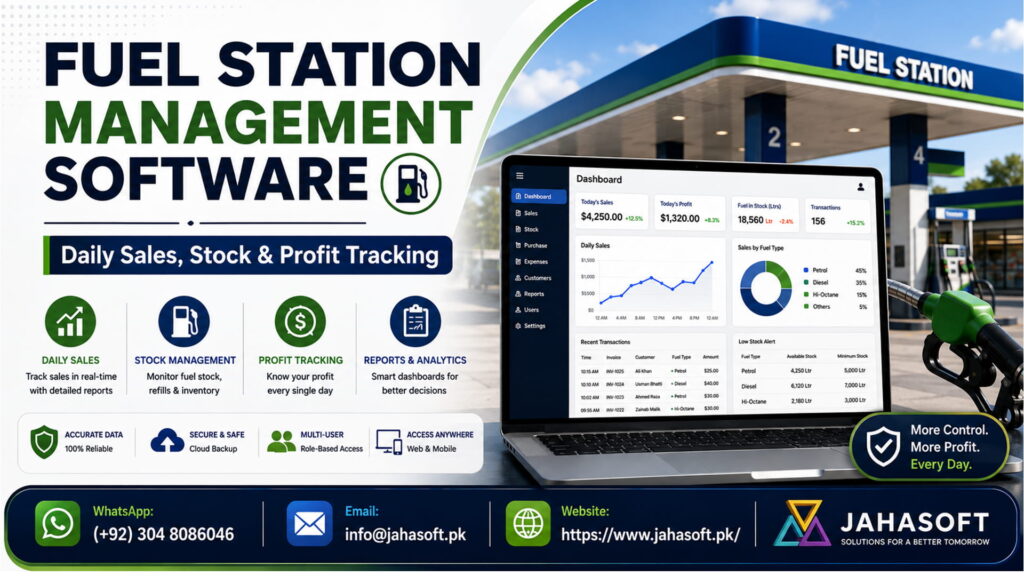
Fuel station management software records every litre sold at each nozzle, matches that figure against the stock physically left in your tanks, and calculates your margin using the rate you actually paid on your last decantation. Instead of closing the day with a register and a calculator, you close it with a report that shows litres sold, cash collected, credit issued, closing stock, and profit per product.
Most pumps in Pakistan still run on a daily sales register, a diary for udhaar, and one person who “knows the numbers.” That works until it doesn’t. Two litres of shortage per thousand goes unnoticed for a month. A shift closes short and nobody can prove which shift. Prices change on the 1st and you have 12,000 litres in the ground that you bought at the old rate, and now nobody is sure what the day’s real margin was.
This is what software fixes, and how.
What is fuel station management software?
Fuel station management software is a system that handles the daily operations of a petrol pump: nozzle meter readings, shift closing, tank stock, purchase invoices, price changes, credit customers, expenses, and reporting. It sits between what your attendants do at the forecourt and what your accountant needs at month end.
A working system answers five questions every single day, without anyone doing arithmetic by hand:
- How many litres of petrol, diesel and HOBC did we sell?
- At what rate did we buy that stock, and what did we sell it for?
- What is the gross profit for the day, per product and in total?
- How much stock is left in each tank right now?
- How much cash came in, how much went out on credit, and does the till balance?
The daily numbers a pump owner actually needs
Litres sold, by nozzle and by shift
Every nozzle has an opening reading and a closing reading. The difference, minus test litres returned to the tank, is what that nozzle sold. Software takes those readings at each shift change, so sales are attributed to a shift and an attendant rather than to a whole day with nobody accountable.
If you run three shifts across six nozzles, that’s 18 readings a day. Doing it on paper is possible. Doing it on paper and then spotting that Nozzle 4’s afternoon shift is consistently 40 litres light every Thursday is not.
Purchase rate versus sale rate
Your margin is not the OGRA-notified price. It is the difference between your invoice rate from the OMC and the retail price you charge, less your own costs. Software stores each decantation as a separate purchase batch with its own rate, invoice number, tanker registration and received quantity. When the retail price is revised, your existing stock is still costed at what you paid for it, so the profit figure reflects reality rather than an assumption.
This matters most on revision days. A pump holding 20,000 litres of diesel bought before an increase makes a very different amount of money than one that took delivery after it. Your report should show that instead of hiding it.
Closing stock and the dip-versus-meter check
Book stock is opening stock, plus purchases, minus meter sales. Physical stock is what the dip rod and the calibration chart say is in the tank. The gap between those two numbers is your variance.
A small variance is normal. Temperature affects volume, and evaporation is real, particularly on petrol in Quetta and Balochistan summers. A variance that grows week over week, or that appears only on certain shifts, is not normal. Software plots that variance as a percentage of throughput so you can see the trend instead of arguing about one bad day.
Credit customers
Almost every pump carries credit: transport companies, government departments, NGOs running field vehicles, contractors, regular account holders. On paper this becomes a diary nobody reconciles until someone disputes a bill.
A credit module records the vehicle number, the driver, the litres, the rate on that date, and the signature or slip reference. At month end it produces a statement you can hand over or email, plus an ageing report that tells you which accounts are past 30, 60 and 90 days. Recovering receivables gets a lot easier when you can show a line-by-line statement instead of a photocopied page.
Cash, expenses and shift reconciliation
Cash sales, card or wallet payments, credit issued, and expenses paid from the till all have to add up against the meter reading for that shift. Software does that reconciliation at the moment the shift closes, so a shortage is identified while the attendant is still standing there. That single change fixes more leakage than any other feature.
How the day works with software in place
A typical day looks like this:
- Morning shift opens. Attendant enters opening nozzle readings and the tank dip on a tablet or phone.
- A tanker arrives. The decantation is entered with the invoice rate, quantity received, and post-delivery dip. Any short delivery is flagged immediately.
- Sales run. Credit customers are billed against their account as they fuel.
- Shift closes. Closing readings, cash counted, expenses recorded. The system reports the difference in seconds.
- Day closes. The owner gets a summary on WhatsApp or email: litres by product, sales value, gross profit, closing stock, credit issued, cash in hand.
The owner does not need to be at the pump for any of this. That is usually the point.
Off-the-shelf or custom?
There are ready-made petrol pump packages you can buy. For a single pump with three tanks, simple credit, and no unusual reporting, one of them may be enough, and I would not talk anyone out of it.
Custom development is worth it when your operation does not fit the box. Common reasons pump owners in Pakistan end up asking for custom work:
- Multiple pumps under one owner, with consolidated reporting and separate site accounts.
- A tuck shop, tyre shop, service station or CNG bay attached to the pump that has to be in the same books.
- Credit customers who need bills in a specific format, especially government and NGO accounts.
- Integration with automation systems or tank level gauges already installed on site.
- Reporting your accountant or auditor wants in a particular structure.
- Urdu interface for attendants and English reports for the office.
JahaSoft builds these as custom systems: web based, mobile friendly, and able to run offline at the forecourt where connectivity drops. Data stays in your account, and the software is yours rather than rented per terminal.
What a deployment involves
Most single-site deployments take three to six weeks from first meeting to going live. The work breaks down roughly as:
- A site visit or call to map your tanks, nozzles, products, shifts and current paperwork.
- Configuration of your tank calibration charts, product list, opening stock and credit accounts.
- Attendant training, which usually takes an afternoon because the daily screens are deliberately simple.
- Two to four weeks of parallel running, where you keep the register alongside the software until the numbers match.
That parallel period is not optional in my view. It is how you build trust in the figures, and it usually surfaces one or two errors in the old register that had been carried forward for months.
What it costs
Pricing depends on the number of sites, the modules you need, and whether you want hardware integration. A single pump with sales, stock, credit and reporting is at the lower end. Multi-site setups with consolidated dashboards, hardware integration and custom bill formats cost more. JahaSoft quotes per project after a scoping call rather than publishing a fixed rate, because a two-nozzle rural pump and a six-nozzle highway station with a service bay are not the same job.
If you want a number to plan around, ask for a written scope and quotation. It costs nothing and gives you something concrete to compare against other vendors.
Talk to us about your pump
If you run a fuel station in Balochistan, Sindh, Punjab or KP and you are tired of finding out about a shortage three weeks late, we can show you what your daily report would look like with your own numbers in it.
JahaSoft builds custom software for fuel stations, NGOs, government departments and businesses across Pakistan, the UK, the US and UAE.
Phone: (+92) 304 8086046
Email: info@jahasoft.pk
Office: Satellite Town, Block 3, Kalat Road, Quetta
It is a system that records nozzle meter readings, tank stock, fuel purchases, credit sales and expenses at a petrol pump, then reports daily litres sold, closing stock and profit per product without manual calculation.
It costs each sale against the purchase rate of the stock actually in the tank, taken from your decantation invoices, and subtracts that from the retail price applied on the day of sale. Because purchase batches are stored separately, a price revision does not distort the margin on stock you bought earlier.
Yes. Nozzle readings are captured at every shift change and tied to the attendant on duty, so short cash and unusual sales patterns can be traced to a specific shift rather than a whole day.
You enter the new retail rate with the date and time it takes effect. Sales before that moment use the old rate, sales after use the new one. Stock purchased at the earlier rate stays costed at what you paid.
Yes. Each account has a running balance, vehicle-wise entries, printable or emailed monthly statements, and an ageing report showing what is overdue at 30, 60 and 90 days.
The system is built to keep working offline at the forecourt and sync when the connection returns, which matters at pumps on highways and in areas with patchy coverage.